Progressive Money

Topic 7 of 8

The global economy

Exchange rates, trade and capital flows, and how much freedom different countries really get from issuing their own currency.

4 lessons · about 53 min with activities, 2 h 30 min with the long lectures · beginner first

Before the videos

Key ideas for this topic

Read the primer first: it covers exchange rates, the current account, foreign debts and the different degrees of monetary sovereignty that the videos assume. Then watch Chang on why economists disagree, Mosler's three-minute case that imports are a benefit, and Kaboub on the IMF and the Global South. Mitchell's 88-minute lecture on the Eurozone is optional depth.

Builds on: Topic 6 looked at what taxes do for a government that issues its own currency; this topic asks how that picture changes once other countries, their currencies and their creditors come in.

Ideas you'll need

1What an exchange rate is, and why Australia's floats

An exchange rate is the price of one currency in terms of another. If one Australian dollar buys 65 US cents, a phone priced at US$650 costs A$1,000 before shipping and GST.

Since December 1983 the Australian dollar has floated: its price is set by supply and demand in foreign exchange markets, not fixed by the government. The RBA explains that the dollar tends to rise when the prices of our commodity exports rise (the terms of trade) and when Australian interest rates are high compared with other countries, and that over shorter periods it moves with the mood of global investors. That is why it is often called a commodity currency.

A falling dollar makes Australian exports cheaper for foreigners and imports dearer for us. RBA research found that most of an exchange rate change, around 80 per cent, shows up in the prices importers pay at the border, much of it within a quarter. Only a small part reaches the overall consumer price index, and slowly, because local costs such as wages, rent and transport make up much of what we pay in shops. The RBA has described the floating dollar as a shock absorber: when commodity prices slump, the dollar falls and cushions the blow to exporters.

2Trade, the current account and capital flows

Exports are what Australia sells to the rest of the world; imports are what we buy. The difference is the trade balance. Add the income Australia pays and receives on investments across borders, such as interest and dividends, plus some transfers, and you get the current account.

The other half of the accounts is the capital and financial account, which records who buys whose assets. Under double-entry bookkeeping the two add up to zero, apart from measurement errors. If Australia buys more from the world than it sells, foreigners must be adding to their holdings of Australian assets, such as shares, bonds, property and bank deposits, by the same amount. This is an accounting identity, not a theory about whether deficits are good or bad.

Australia ran current account deficits for most of the period from the mid-1970s, using foreign capital to fund more investment than domestic saving covered. It moved into surplus in mid-2019 for the first time since 1975, but was back in deficit by $27.2 billion in the June quarter of 2026. The accumulated result of past deficits is Australia's net foreign liabilities: what foreigners own in Australia minus what Australians own abroad, which the ABS put at $638.9 billion at 30 June 2026.

3Whose currency are the debts in?

Owing money to foreigners is not automatically dangerous. What matters a great deal is the currency the debts are in.

An RBA study of the ABS's 2022 survey found that around three-quarters of Australia's foreign liabilities are in Australian dollars, while most of our foreign assets, largely superannuation funds' overseas shares, are in foreign currencies. Banks, the main borrowers in foreign currency, hedge most of it with derivatives. Overall Australia has a net foreign currency asset position. So when the dollar falls, the Australian-dollar value of our foreign assets rises, and our net foreign liabilities shrink rather than grow.

Many countries are in the opposite position. If a government or its businesses borrow in US dollars, every fall in the local currency raises the local-currency cost of each repayment. That is how a currency crisis turns into a debt crisis. Economists call the difficulty many countries have in borrowing abroad in their own currency original sin. Research at the Bank for International Settlements suggests that borrowing in local currency reduces this vulnerability but does not remove it, because foreign lenders still pull back when global conditions tighten.

4Degrees of monetary sovereignty

Countries differ in how much control they have over their own money. It helps to think of a spectrum.

  • Floating own-currency issuers, such as Australia, the United States, the United Kingdom and Japan. The government spends and borrows in a currency its own central bank issues, and the exchange rate moves freely. It cannot run out of that currency, but it can still run into inflation, exchange-rate and real-resource limits.
  • Pegs and currency boards. Hong Kong keeps its dollar between 7.75 and 7.85 to the US dollar, and its monetary base is fully backed by US dollar assets, so local interest rates adjust automatically to defend the peg. That buys stability at the cost of independent interest-rate policy.
  • Members of a currency union. The 21 EU countries in the euro area spend a currency none of them issues alone. The economist Paul De Grauwe argued this leaves them exposed to market panics, rather like emerging economies.
  • Countries with large foreign-currency debts. Many developing countries issue their own currency but owe heavily in US dollars, so a falling exchange rate can make their debts unpayable.

Real countries can sit between these categories, and their position can change.

5Issuing a currency does not make a country self-sufficient

Even a floating currency issuer depends on the rest of the world for things it does not make, or does not make enough of. Australia buys much of its fuel, many medicines and a great deal of machinery and equipment from overseas. Paying for them takes foreign currency, which Australians obtain by selling exports, attracting foreign investment or borrowing.

The Australian Government can create Australian dollars. It cannot create the US dollars an overseas fuel supplier wants; Australians can only buy them on the market, and if many more Australian dollars are offered, their price falls. A sharp fall in the dollar makes imports dearer and can add to inflation for a while.

MMT economists accept this. They argue that for a country like Australia the binding limits are real resources and inflation rather than finance, and that the floating exchange rate absorbs external shocks. Critics give more weight to the risk that very large deficits or very low interest rates could weaken the currency and push up prices. For countries that must import food and fuel and owe in dollars, Kaboub argues, the external constraint is the one that bites first. Keep this in mind as you watch: 'the government can always pay' is true of debts in its own currency, and it is not the whole story.

Saved in this browser only. It records that you marked it, nothing more.

Lesson 7.1 Beginner11 min video Core about 19 min with questions

RSA ANIMATE: Economics is for Everyone!

Ha-Joon Chang · Royal Society of Arts

Before you watch

After watching this video, you should be able to explain why Chang thinks no single school of economics is enough, using his Singapore example.

Why this matters. Every video in this topic involves economists who disagree about trade, currencies and debt. Knowing that schools of thought start from different assumptions and values helps you weigh their arguments rather than just picking a side.
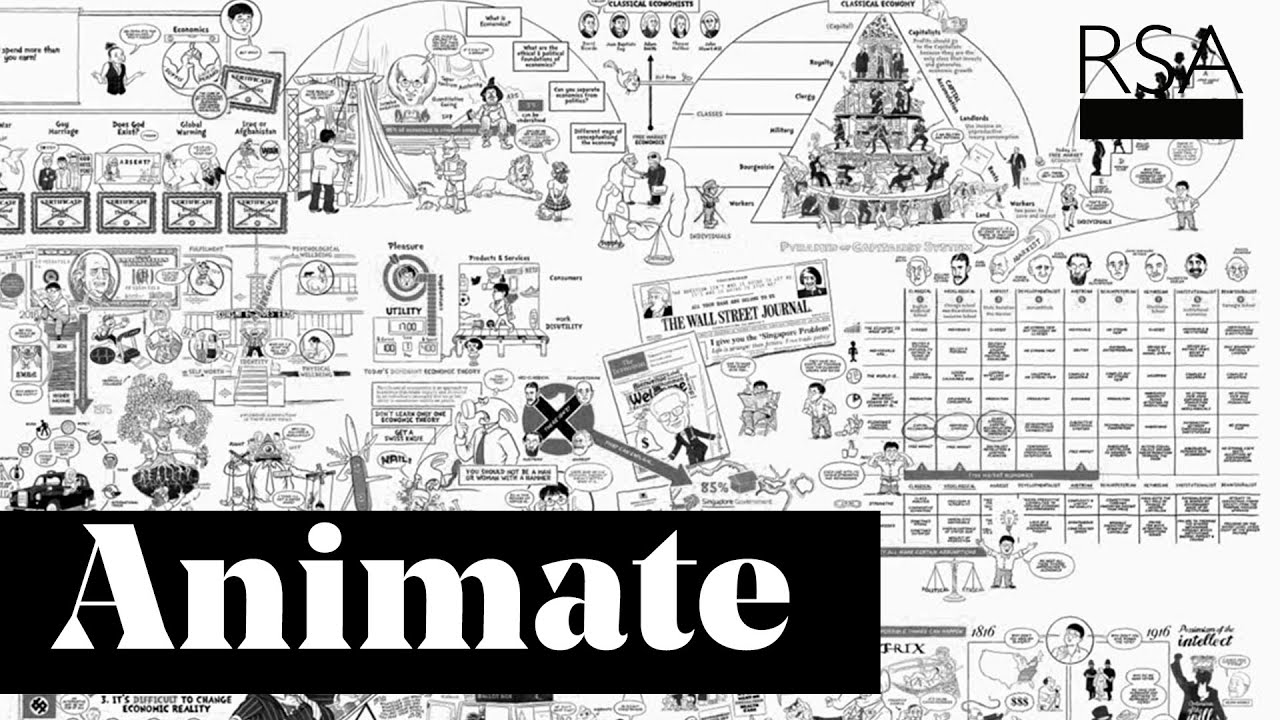
RSA ANIMATE: Economics is for Everyone!
Play: RSA ANIMATE: Economics is for Everyone! (11 minutes, opens YouTube)

Chang's eleven-minute animated talk, drawn from his book Economics: The User's Guide, argues that economics is not one settled science but several schools with different assumptions and values, and that ordinary citizens can and should judge economic arguments. His main example is Singapore, whose success he says no single theory can explain. It is not about trade as such: it opens this topic because the global economy is where economists disagree most openly, and it is a fair summary of what this whole site is trying to do.

Three things to remember

  1. Established Economics has several distinct schools of thought, such as neoclassical, Keynesian, Marxist, Austrian and institutionalist economics, which start from different assumptions about how economies work and what matters.
  2. Argument Chang argues that Singapore's success cannot be explained by free-market theory alone, because alongside free trade and foreign investment the state owns most of the land, provides most housing and runs large enterprises.
  3. Argument Chang argues that people without economics degrees can form sound economic judgements, that economists should be treated with healthy scepticism, including himself, and that simply deferring to experts sits uneasily with democracy.

Can you explain it?

Optional. Try as often as you like; nothing is scored or sent anywhere.

Chang uses Singapore to make a point about economic theory. Which statement best captures it?

Show the answer

No single school of economics explains Singapore; you need several to understand it.

Right. He accepts that free trade and foreign investment mattered, but says state ownership of land, public housing and state enterprises mattered too, and no one theory covers all of that.

Chang says you should 'never trust an economist', including him. What does he mean, and what is a sensible way to apply that advice?

Show a model answer

He means no economist has a monopoly on truth, because each school rests on assumptions and values that shape its conclusions. That is not a reason to ignore economists, but to ask what each one is assuming, what evidence they rely on, and whose interests their recommendation serves. A sensible approach is to listen to more than one school, separate claims of fact from value judgements, and notice where the evidence is strong and where it is thin. Chang's other advice, to 'listen even to the other side', points the same way.

A strong answer

  • Economists' conclusions depend on assumptions and values
  • Scepticism means questioning, not dismissing, expert views
  • Separating evidence from value judgements

Lesson 7.2 Beginner3 min video Core about 11 min with questions

Real Terms Of Trade: Imports are a Benefit, Exports are a Cost

Warren Mosler, Stephanie Kelton · Deficit Owls

Before you watch

After watching this video, you should be able to explain what Mosler means by 'real terms of trade', and name two concerns his framing leaves aside.

Why this matters. Australian politics often treats exports as wins and imports as losses. Seeing trade in real terms, as goods and services gained and given up, clarifies what trade is for, and where the genuine risks lie.

Real Terms Of Trade: Imports are a Benefit, Exports are a Cost
Play: Real Terms Of Trade: Imports are a Benefit, Exports are a Cost (3 minutes, opens YouTube)

A three-minute clip in which Mosler, in conversation with Stephanie Kelton, makes the case that in real terms imports are a benefit and exports a cost: what a country gets to consume is what it produces plus what it imports, minus what it ships away. His example is Japan sending the United States millions of cars a year in exchange for financial assets. It is deliberately provocative, and it skips the questions of jobs, strategic industries and the exchange rate, which the lesson below covers.

Three things to remember

  1. Established In real terms, exports are goods and services a country produces but does not get to use, and imports are goods and services it uses without producing them. That is an accounting description, not a policy recommendation.
  2. Argument Mosler argues that a trade deficit raises living standards, and that if imports cost local jobs, the government should use fiscal policy to keep enough spending in the economy to employ those workers elsewhere.
  3. Established In practice, Australia pays for imports through exports, foreign investment or borrowing, and a weaker dollar quickly raises the Australian-dollar price of imports at the border.

Can you explain it?

Optional. Try as often as you like; nothing is scored or sent anywhere.

The Australian dollar falls sharply against the US dollar. What is most likely to happen to petrol prices in Australia over the following weeks?

Show the answer

They rise, because imported fuel is priced in US dollars and now costs more Australian dollars.

Right. RBA research finds most of an exchange rate change passes into import prices at the border, much of it within a quarter. Fuel prices tend to respond quickly because much of their cost is the imported product itself.

Mosler says imports are a benefit. Give one reason a country might still worry about running large trade deficits for many years.

Show a model answer

One worry is jobs: imports can wipe out an industry concentrated in a few towns, and those workers do not automatically find new work, even if the economy as a whole is fine. Another is resilience: relying on imports for fuel or medicines is risky if supply is cut off in a crisis. A third is financial: a deficit is matched by foreigners adding to their holdings of the country's assets, and if they stop wanting to, the currency can fall sharply and import prices rise.

A strong answer

  • Job losses concentrated in particular industries or regions
  • Strategic dependence on imports of essentials
  • Reliance on foreigners continuing to hold the country's assets, and exchange rate risk

Lesson 7.3 Beginner11 min video Core about 17 min with questions

Whose interest does the IMF really serve? Fadhel Kaboub explains

Fadhel Kaboub

Before you watch

After watching this video, you should be able to explain why Kaboub sees food, energy and manufacturing deficits, rather than debt itself, as the root problem for Global South countries.

Why this matters. Australia's freedom as a currency issuer rests partly on earning enough from exports to buy what it imports. Many countries cannot, and this lesson shows what monetary sovereignty looks like when it is incomplete.

Whose interest does the IMF really serve? Fadhel Kaboub explains
Play: Whose interest does the IMF really serve? Fadhel Kaboub explains (11 minutes, opens YouTube)

Kaboub, interviewed on a Sri Lankan current-affairs program, argues that the IMF and World Bank belong to a colonial-era economic architecture that keeps the Global South supplying cheap raw materials and importing technology, and that countries should cooperate regionally to build their own food, energy and manufacturing capacity. About ten minutes, including the host's introduction. It shows why issuing your own currency is not enough when you must import essentials priced in someone else's.

Three things to remember

  1. Argument Kaboub argues that the IMF and World Bank work within a colonial economic architecture that keeps the Global South supplying raw materials, buying the North's technology and hosting low-value assembly work.
  2. Argument Kaboub argues that foreign borrowing is a symptom: countries that must import food, fuel and manufactured goods keep needing dollars, so the cure is building those capacities, ideally through regional South-South cooperation.
  3. Official view The IMF says its loan conditions require governments to fix the policies behind their balance of payments problems, and to stay able to repay, so its resources remain available to other members.

Can you explain it?

Optional. Try as often as you like; nothing is scored or sent anywhere.

A Newcastle hospital orders a scanner priced at US$600,000. When it orders, A$1 buys US$0.75. When it pays, A$1 buys US$0.60. How many more Australian dollars does the scanner cost?

Show the working

Answer: $200,000

At US$0.75, the scanner costs 600,000 ÷ 0.75 = A$800,000. At US$0.60, it costs 600,000 ÷ 0.60 = A$1,000,000. The extra cost is A$200,000, a 25 per cent rise, with no change in the US price. For a country that must import fuel or food and has a weak currency, this happens to essentials.

According to Kaboub, why do many Global South countries keep returning to the IMF?

Show the answer

Structural deficits in food, energy and manufacturing mean they keep needing foreign currency they cannot earn.

Right. Kaboub treats the debt as a symptom: dependence on imported essentials creates a constant need for dollars, which leads to borrowing and then crises.

Lesson 7.4 Intermediate88 min video Long lecture · optional about 1 h 35 min with questions

Joan Muysken Lecture: "The Eurozone, Groupthink and denial on a grand scale"

Bill Mitchell · UM | School of Business and Economics

Before you watch

After watching this video, you should be able to explain why Mitchell thinks a currency union without a central budget leaves member governments exposed in a downturn.

Why this matters. The Eurozone is the clearest case of rich, democratic governments that spend a currency they do not issue. Comparing it with Australia's federation shows what monetary sovereignty does and does not provide.

Joan Muysken Lecture: "The Eurozone, Groupthink and denial on a grand scale"
Play: Joan Muysken Lecture: "The Eurozone, Groupthink and denial on a grand scale" (88 minutes, opens YouTube)

Mitchell's Maastricht lecture, based on his book Eurozone Dystopia, argues that the euro was flawed from the start: it bound very different economies to one currency without a central budget able to support a region in a slump. He traces the story from Europe's failed currency pegs of the 1970s to the Greek crisis, and concludes that an orderly breakup, or national exits, would be better. It runs 88 minutes, the last 25 or so audience questions, and was recorded when the euro had 19 members; it now has 21.

Three things to remember

  1. Established Eurozone governments spend and borrow in euros, but none of them issues the euro. Investors can therefore doubt their ability to repay in a way that does not apply to Australia's federal government and its Australian-dollar debt.
  2. Argument Mitchell argues a currency union only works with a large central budget, as in Australia, where the federal government moves money to states or regions in trouble, and that Europe lacks the solidarity to build one.
  3. Argument Mitchell argues that austerity after 2010 deepened the crisis, that the European Central Bank kept the euro intact by in effect buying government debt, and that Greece and Italy would be better off leaving.

Can you explain it?

Optional. Try as often as you like; nothing is scored or sent anywhere.

In Mitchell's comparison, what does Australia's federation have that the Eurozone lacks?

Show the answer

A national government that issues the currency and can move large sums to states or regions in trouble.

Right. Mitchell's point is that Tasmania and Victoria share a currency and a federal budget, so transfers flow without anyone noticing. Eurozone members share only the currency.

Greece's crisis had several causes. Name two explanations economists give, and say which Mitchell emphasises.

Show a model answer

Mitchell emphasises the euro's design: Greece spent and borrowed in a currency it could not issue, there was no European budget to cushion its slump, and the austerity imposed after 2010 made things worse. Other explanations stress Greece's own large deficits and debts; a loss of competitiveness as its costs rose faster than Germany's, leaving big current account deficits; and banking, as capital flowed into booms and bank rescues later landed on governments. Mitchell touches on these, for example German wage restraint and capital flowing into Irish and Spanish property, but treats design as the root.

A strong answer

  • Design: no currency-issuing central budget behind member governments
  • At least one other explanation: fiscal, competitiveness or banking
  • Recognition that causes can combine

Saved in this browser only. It records that you marked it, nothing more.

Continue learning

That completes the global picture; the next topic brings these ideas home to Australian housing, where bank credit, interest rates, tax and land meet.

Next: where this topic is contested

The big debate in this topic

How much freedom does issuing your own currency really give a country?

Saved in this browser only. It records that you marked it, nothing more.

Where this leads. Topic 8 brings the lens home to Australian housing, where bank credit, interest rates, tax settings and land supply meet in most households' biggest purchase.

Go further (optional, more advanced)