Progressive Money

Topic 6 of 8

Tax

What taxes do in an economy whose government issues its own currency, why MMT and mainstream economists describe their role differently, and how Australia taxes housing, land and work.

4 lessons · about 1 h 10 min with activities · beginner first

Before the videos

Key ideas for this topic

The primer sets out the jobs taxes do, from restraining inflation to their legal role in the budget, and separates MMT's claim about currency issuance from those roles. Then Warren Mosler's short clip on taxes and inflation, Greg Jericho on negative gearing, Michael Hudson on economic rent, and Richard Denniss on Australia's tax mix.

Builds on: The Government spending and Jobs topics argued that a currency issuer can afford to spend on jobs and services; this topic asks what taxes are then for, and how Australia's tax settings shape who gains.

Ideas you'll need

1What taxes do

Whatever you think about how government spending is financed, taxes do several distinct economic jobs.

  • Making room for public spending without inflation. Tax reduces what households and businesses can spend, which frees up workers and materials for public use. If the government hires 10,000 more nurses, taxes help stop the economy trying to buy more than it can produce.
  • Distribution. Progressive income tax takes a larger share of higher incomes. In 2026–27 the rates are 0, 15, 30, 37 and 45 per cent across income brackets, plus a 2 per cent Medicare levy.
  • Incentives and discouraging harms. Tobacco excise makes smoking dearer; a price on carbon would do the same for emissions.
  • Resource allocation. Tax rules steer money towards some uses. Rental losses can be deducted from wages, and capital gains on assets held over a year are taxed on only half the gain, so property investment is favoured over some alternatives. Both settings change from 1 July 2027 (see the Housing topic).
  • The institutional role of revenue. Revenue sits at the centre of the legal and political budget process, covered in the third section below.

Economists of every school accept the first four. They disagree about how to describe the fifth, and about how to judge the right overall level of tax.

2How much Australia taxes, and how

OECD figures put Australia's total tax at 29.4 per cent of GDP in 2022, below the OECD average of 34.0 per cent. The mix is unusual. Personal income tax supplies 40 per cent of Australian tax revenue, against an OECD average of 24 per cent, and Australia collects no social security contributions, which in many countries fund pensions. Instead, employers pay compulsory superannuation into private funds, which is not counted as tax. That is one reason people argue about whether Australia is a 'low-tax' country.

You also need the idea of a marginal tax rate: the rate on your next dollar of income. In 2026–27, someone earning $100,000 pays 30 cents on each dollar between $45,000 and $135,000. A $1,000 tax deduction saves them $300 in income tax, or $320 including the Medicare levy. The same deduction saves someone earning over $190,000 $450, or $470 with the levy, so deductions are worth more to higher earners.

Your average rate, total tax divided by income, is lower than your top marginal rate. On $100,000, income tax in 2026–27 is $20,520, an average rate of about 20.5 per cent, not 30.

3The rules around revenue

In Australia, revenue also has legal and political jobs. Section 81 of the Constitution sends all Commonwealth receipts into one Consolidated Revenue Fund, and section 83 says no money can be drawn from it without an appropriation made by law. Parliament, not the government alone, authorises spending.

When spending exceeds tax, the Australian Office of Financial Management issues Commonwealth bonds, and it forecasts daily cash flows so the government can always make its payments.

Revenue also anchors political accountability. After each general election, the Parliamentary Budget Office publishes the budget impact of the major parties' commitments, so voters can compare promises with their cost. Governments set themselves fiscal rules; the Coalition government, for example, capped Commonwealth tax at 23.9 per cent of GDP.

None of these arrangements is a law of economics. They are laws and conventions Parliament chose and could change. But while they stand, revenue shapes what governments can do, what they can promise, and how they are judged.

4Two claims to keep apart

MMT economists make an operational argument: a government that issues its own currency does not need to collect taxes before it can spend. In Randall Wray's summary, taxes are not needed to 'pay for' spending. Their jobs are to create demand for the currency, hold total spending in check, redistribute, and discourage harms. The real limits on spending are inflation and real resources.

Mainstream economists such as Gregory Mankiw accept that a currency issuer can always pay its bills in its own money. But they argue that financing spending by creating money or issuing bonds still has costs: interest must be paid, and leaning on money creation fuels inflation.

So keep two questions separate. Can the Australian Government run out of Australian dollars? No. Does tax revenue matter in practice? Yes: for inflation, for distribution, and under Australia's laws, budget rules and politics. Both sides agree that taxes matter for inflation. The live disagreement is how to judge the right level of tax, and whether saying taxes do not 'fund' spending clarifies or misleads.

5Economic rent, and why land is different

Economists use rent in a special sense: income above what is needed to bring something into use. Land is the classic case. Its supply is fixed, so nothing extra is needed to call it into existence, and its whole return is rent. Classical economists built theories around this, including David Ricardo in his 1817 Principles of Political Economy and Taxation. In 1879 Henry George proposed a 'single tax' on land value to replace all other taxes. The idea extends to monopolies and scarce natural resources.

Because land cannot move or be produced, a tax on its value is hard to avoid and does not reduce the amount of land. Treasury modelling in 2015 found that a hypothetical broad-based land tax would be Australia's most efficient major tax, while stamp duty on property transfers and company tax were the least efficient.

This is a point where mainstream and heterodox economists largely agree. They disagree about how large rent is beyond land, and how quickly the tax base should shift.

Saved in this browser only. It records that you marked it, nothing more.

Lesson 6.1 Intermediate4 min video Core about 12 min with questions

Universal Healthcare Probably Requires LOWER Taxes, Not Higher

Warren Mosler · Deficit Owls

Before you watch

After watching this video, you should be able to explain why Mosler judges a tax rise by its effect on spending and inflation, not whether it 'pays for' a program.

Why this matters. Every big Australian policy proposal meets the question 'how will you pay for it?'. Mosler's answer is unusual, and seeing why it is contested sharpens what that question really asks.

Universal Healthcare Probably Requires LOWER Taxes, Not Higher
Play: Universal Healthcare Probably Requires LOWER Taxes, Not Higher (4 minutes, opens YouTube)

A four-and-a-half-minute excerpt from Steve Grumbine's interview with Warren Mosler for Real Progressives, about Medicare for All in the United States and how Bernie Sanders' campaign proposed to pay for it. Mosler argues that a single public health insurer would remove a large amount of private administrative spending, so the real question is whether the economy then needs more or less spending, not how to 'pay for' the program. The context is American: Australia already has Medicare.

Three things to remember

  1. Established This clip is about the US, which has no universal public health insurance. Australia already has Medicare, and taxpayers generally pay a 2 per cent Medicare levy on top of income tax.
  2. Official view In Australia the Parliamentary Budget Office reports the budget impact of each major party's election commitments. That is the 'how will you pay for it?' frame Mosler rejects as the main test.
  3. Argument Mosler argues Medicare for All would remove roughly US$1 trillion of private administrative spending, a deflationary shock, so raising taxes at the same time would push up unemployment.

Can you explain it?

Optional. Try as often as you like; nothing is scored or sent anywhere.

Mosler calls Medicare for All 'deflationary'. What is his reasoning?

Show the answer

It would remove a large amount of private spending on health administration, so total spending would fall unless something replaced it.

Yes. His point is about total spending: if administrative wages disappear, demand falls, so adding a tax rise on top would make things worse. He concedes some offsetting effects, such as households no longer paying premiums.

Suppose the federal government proposes free childcare costing $10 billion a year. Using Mosler's framework, what would you want to know before deciding whether to raise taxes? What would a mainstream economist add?

Show a model answer

Mosler would ask whether the economy has spare capacity: enough educators, centres and equipment to deliver it, and whether extra spending would push total demand past what the economy can produce. He would also count offsets, such as parents working more and household budgets freed up. If inflation risk is low, no tax rise is needed. A mainstream economist would add the PBO costing and budget rules, the interest cost of extra borrowing, and the political test of whether voters accept the cost.

A strong answer

  • Asks about real resources (workers, centres) and inflation, not just the dollar cost.
  • Mentions offsetting effects on spending, such as extra workforce participation.
  • Adds at least one practical role of revenue: budget rules, interest costs, PBO costings or accountability.
Saved in this browser only. It records that you marked it, nothing more.

Continue learning

Mosler treats tax as a lever on total spending. Greg Jericho shows how particular tax rules also change who buys what, starting with investment housing.

Next: Negative Gearing Explained | Greg Jericho on the Project

Lesson 6.2 Beginner8 min video Core about 14 min with questions

Negative Gearing Explained | Greg Jericho on the Project

Greg Jericho · The Australia Institute

Before you watch

After watching this video, you should be able to explain how negative gearing reduces an investor's tax and how the capital gains discount works when a property is sold.

Why this matters. These two concessions are among the most debated in Australian tax and cost billions of dollars a year. The May 2026 Budget narrowed both from 1 July 2027 (see the Housing topic), so this clip describes the settings before the change. They still apply until 1 July 2027; after that, negative gearing continues for properties held before 12 May 2026, and the 50 per cent discount for gains accrued before July 2027.

Negative Gearing Explained | Greg Jericho on the Project
Play: Negative Gearing Explained | Greg Jericho on the Project (8 minutes, opens YouTube)

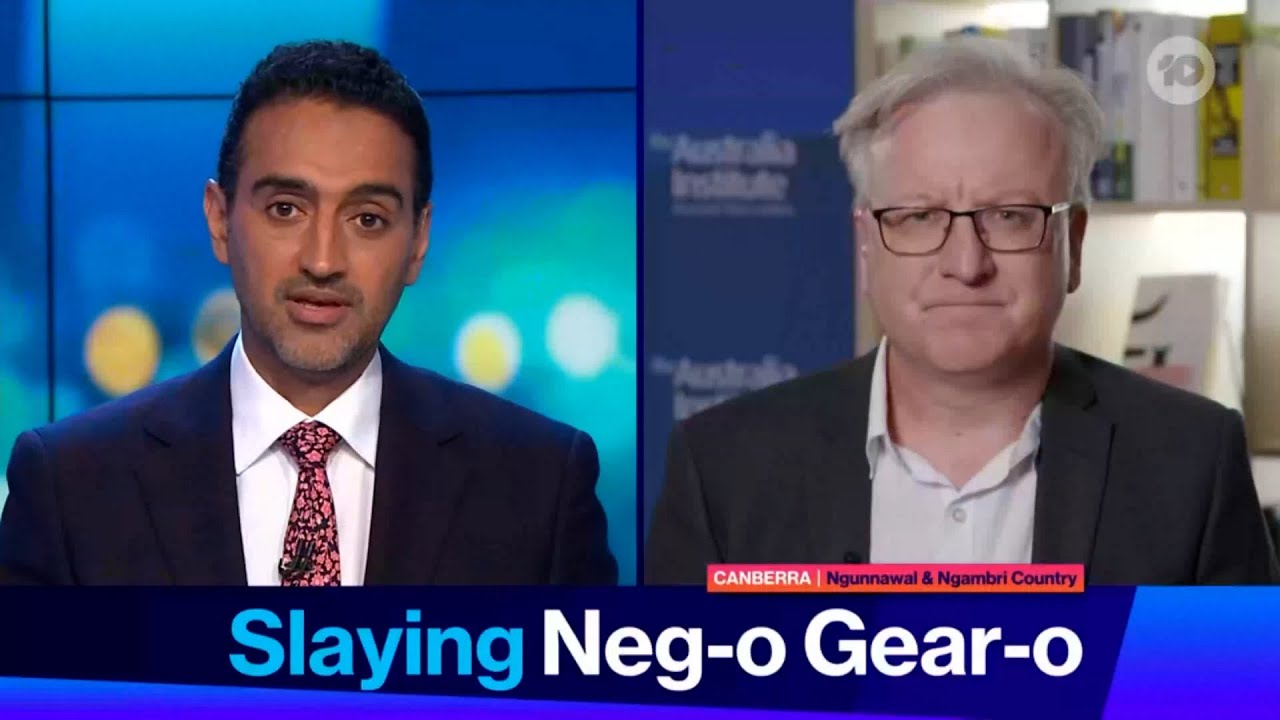
An eight-minute segment from The Project, recorded in 2024 after the Stage 3 tax cuts were redesigned. A comic explainer of negative gearing and the capital gains tax discount is followed by an interview with Greg Jericho of The Australia Institute, who argues the two concessions mostly benefit higher earners and give investors an edge over home buyers. Quick and clear, though some figures quoted in it differ from official estimates.

Three things to remember

  1. Established Negative gearing lets an investor deduct a rental loss from other income, such as wages, cutting tax at their marginal rate. When an asset held at least 12 months is sold, only half the capital gain is taxed.
  2. Official view The Parliamentary Budget Office estimated in 2025 that negative gearing would cost $7.4 billion and the residential capital gains discount about $6 billion in 2025–26. Figures quoted in the clip use different methods.
  3. Argument Jericho argues the concessions mainly benefit high earners, who claim more and larger losses, and let investors outbid home buyers for a limited stock of houses. He suggests capping claims rather than abolishing them.

Can you explain it?

Optional. Try as often as you like; nothing is scored or sent anywhere.

Priya earns $100,000 in 2025–26. Her investment unit earns $26,000 rent but costs $34,000 a year in interest and expenses. Ignoring the Medicare levy, how much less income tax does she pay because of negative gearing?

Show the working

Answer: $2,400

Her rental loss is $34,000 − $26,000 = $8,000. Deducting it cuts her taxable income from $100,000 to $92,000, all within the 30 per cent bracket ($45,001 to $135,000), so her tax falls by 30 per cent of $8,000, which is $2,400. She is still $5,600 out of pocket, so she is counting on a capital gain, which is taxed at half rate.

Jericho says negative gearing is different from a small business claiming a loss. What is his argument?

Show the answer

A business aims to make a profit and doesn't stop others starting one; a geared investor buys from a limited stock of homes, competing with would-be owners.

Yes. His point is about purpose and scarcity. Supporters reply that investors also supply rental housing, which is part of why the price and rent effects are debated.

Saved in this browser only. It records that you marked it, nothing more.

Continue learning

Why do so many economists single out land and housing for tax reform? Michael Hudson's short clip introduces the older idea underneath: economic rent.

Next: Michael Hudson Part 4 Economic Rent

Lesson 6.3 Intermediate3 min video Core about 11 min with questions

Michael Hudson Part 4 Economic Rent

Michael Hudson · Renegade Inc.

Before you watch

After watching this video, you should be able to define economic rent and explain why economists of many schools regard a broad tax on land value as efficient.

Why this matters. Australia taxes wages heavily and land comparatively lightly, and stamp duty is among its least efficient taxes. The idea of rent explains why land tax reform keeps coming back.

Michael Hudson Part 4 Economic Rent
Play: Michael Hudson Part 4 Economic Rent (3 minutes, opens YouTube)

A three-and-a-half-minute excerpt in which Hudson summarises the classical idea of economic rent: income from owning land, natural resources or monopolies rather than from producing anything. He argues that taxing that rent, as economists from John Stuart Mill to Henry George proposed, would keep property prices down and lighten taxes on work. His examples are American, and his biggest numbers are his own estimates.

Three things to remember

  1. Established Economic rent is income above what is needed to bring something into use. Land's supply is fixed, so its whole return is rent. Henry George proposed a single tax on land value in 1879.
  2. Official view Treasury modelling (2015) found a hypothetical broad-based land tax would be the most efficient major tax, while stamp duty on property transfers and company tax were the least efficient.
  3. Argument Hudson argues rent absorbs about a third of the US economy and that taxing it fully would let governments stop taxing labour. These are his own estimates; few economists backed George's single tax.

Can you explain it?

Optional. Try as often as you like; nothing is scored or sent anywhere.

Why do economists regard a tax on land value as efficient?

Show the answer

Land's supply is fixed, so the tax cannot reduce the amount of land; it mostly lowers what land sells for.

Yes. A tax on wages can discourage work and a tax on buildings can discourage building, but a tax on land value cannot make less land exist. Its cost falls on landowners through lower land prices.

A Newcastle family pays $40,000 in stamp duty when they buy a home. Explain why many economists would prefer an annual land tax raising the same revenue over time.

Show a model answer

Stamp duty is a large one-off tax on buying, so it discourages people from moving: retirees stay in big houses, workers turn down jobs in other cities, and homes are used less well. Treasury modelling ranks it among the least efficient taxes. An annual land tax is paid whether or not you move and cannot reduce the amount of land, so it changes behaviour far less. The hard part is the switch: families who just paid stamp duty, and owners with valuable land but low incomes, need transition rules.

A strong answer

  • Explains that stamp duty discourages moving or transactions.
  • Explains why a land value tax distorts behaviour less.
  • Recognises transition problems, such as people who have already paid stamp duty.

Lesson 6.4 Intermediate19 min video Go deeper about 27 min with questions

Australia's tax dilemma: the case for real reform | Richard Denniss National Press Club Address

Richard Denniss · The Australia Institute

Before you watch

After watching this video, you should be able to explain why Australia's tax-to-GDP ratio looks low by OECD standards and give one reason critics say the comparison misleads.

Why this matters. Debates about tax cuts and public services keep returning to whether Australians are over- or under-taxed. This talk makes one side's case clearly, using the Stage 3 decision as its example.

Australia's tax dilemma: the case for real reform | Richard Denniss National Press Club Address
Play: Australia's tax dilemma: the case for real reform | Richard Denniss National Press Club Address (19 minutes, opens YouTube)

Denniss's 19-minute opening address at a National Press Club debate with Allegra Spender MP on 31 January 2024, as the Stage 3 tax cuts were being redesigned. He argues Australia is a low-tax country, under-taxes wealth, pollution and gas, and should judge tax by what it lets us do together. He was then Executive Director of The Australia Institute and is now its co-Chief Executive.

Three things to remember

  1. Established OECD figures put Australia's tax at 29.4 per cent of GDP in 2022, below the OECD average of 34.0 per cent. Personal income tax supplies 40 per cent of Australian tax revenue, against an OECD average of 24 per cent.
  2. Official view From 1 July 2024 the redesigned Stage 3 cuts lowered the 19 per cent rate to 16 per cent and the 32.5 per cent rate to 30 per cent, and raised the 37 and 45 per cent thresholds.
  3. Argument Denniss argues Australia under-taxes wealth, pollution and gas, citing his institute's estimate of $11 billion a year of fossil fuel subsidies, mostly fuel tax credits, which others dispute.

Can you explain it?

Optional. Try as often as you like; nothing is scored or sent anywhere.

Denniss says Australia does not over-rely on income tax, even though 40 per cent of its tax comes from it. What is his reasoning?

Show the answer

Income tax is a large share only because total tax is low and other bases, such as wealth and pollution, are barely taxed.

Yes. A share depends on what else is in the total. He argues the fix is to tax other bases more, not to cut income tax. Critics also point to the missing social security contributions.

Robert Carling of the Centre for Independent Studies argues Australia is not low-taxing once compulsory super is considered. Explain his point and how Denniss might respond.

Show a model answer

Carling notes that many OECD countries fund pensions through compulsory social security contributions, which count as tax, while Australia's equivalent, the superannuation guarantee, goes into private funds and does not. Adding super, or removing those contributions, narrows the gap. Denniss might reply that super is saved in individuals' own accounts rather than pooled for public services, so it does not fund schools or hospitals, and that the gap in revenue for public services remains.

A strong answer

  • Explains that social security contributions count as tax but super does not.
  • Gives a plausible response about what the comparison is meant to measure.

Saved in this browser only. It records that you marked it, nothing more.

Continue learning

Denniss compares Australia with other countries. The Global economy topic looks at what trade, exchange rates and open capital markets mean for a country's choices.

Next: where this topic is contested

The big debate in this topic

Do taxes fund government spending?

Saved in this browser only. It records that you marked it, nothing more.

Where this leads. The Global economy topic looks beyond Australia's borders: trade, exchange rates, and why countries without their own currency face different limits.

Go further (optional, more advanced)